Dynamics of Algal Blooms and Red Tides in Coastal Waters:
Monitoring, Modelling and Prediction
A Deterministic Lagrangian Particle Method for Water Quality Modelling (Poster)
Introduction
Many coastal water quality problems are advection-dominated, e.g. the vertical migration of motile algae in stable stratified water. For some ecological problems, it is necessary to follow changes in the organism status (e.g. nutrient reserve in an assemblage of algal cells). A robust Lagrangian method without numerical diffusion or dispersion is hence needed.
The Neighborhood
Separation Technique (NEST)
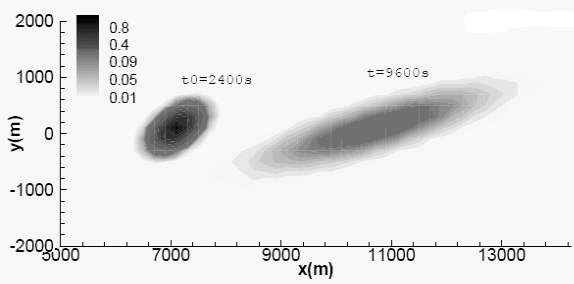
We have developed a new deterministic particle method for advection diffusion problems. Based on relative diffusion concepts, the method simulates diffusion via a simple local interaction rule between neighboring particles. This neighborhood particle separation technique (NEST) is essentially a deterministic Lagrangian implementation of the diffusion process. Compared to the random walk modeling, the method is much simpler and requires far less particles to produce the same result. The capability of NEST to solve the advective- diffusion equation in 1-and 2-D has been demonstrated in extensive numerical tests and practical application.

Schematic representation of diffusion process in NEST

Numerical Scheme of NEST
Numerical testing
-
Diffusion of a Gaussian cloud
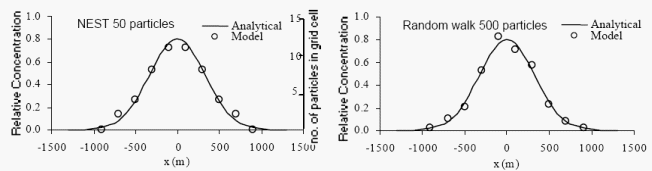
Comparison of model result with analytical solution and random walk at t=9600s
-
2D advective-diffusion in plane shear flow
Application
Yung Shue Au fish culture zone
3000 particles were released at t=0 and the flushing time was determined from the rate of change of tracer mass inside the fish culture zone. The flushing time of the fish culture zone in the dry season was determined using a numerical tracer method to be 10 days. The result obtained using NEST was similar to that obtained using random walk with 20,000 particles. This shows the high computational efficiency of NEST.
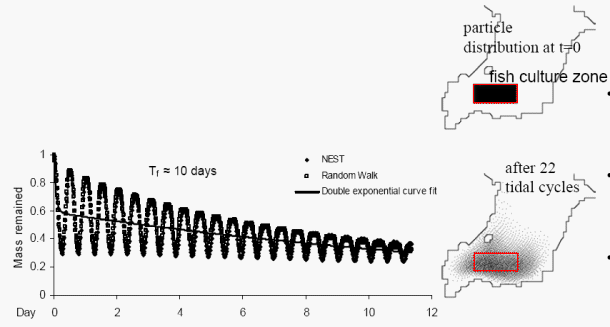
Numerical tracer experiment for Yung Shue Au fish culture zone
Vertical structure model of algal and dissolved oxygen dynamics
The algal bloom in Kat O March 2001 was simulated with 100 particles representing the algae in the water column. Dissolved oxygen and other ambient parameters were simulated using FTCS finite difference scheme. The model is able to simulate the short term trends in algal and dissolved oxygen dynamics and new insights were obtained on extraordinary growth and respiration characteristics during blooms of motile algae.

Vertical profile of chlorophyll and dissolved oxygen on 24March 2001, Kat O
